Article summary:
AI music is often discussed as a threat to musicians, producers and traditional songwriting. Those concerns are real and should be taken seriously. Yet from a lyric writer’s point of view, AI-assisted music may also create something positive. It may make words matter again.
For me… Matthew Sweetapple, songwriter and creator of The Radiation, working with Suno has changed the starting point of songwriting. Instead of always beginning with a guitar, chords and a half-formed melody, the process can now begin with a lyric, a story, a character or a strange idea that might once have stayed in a notebook.
I appreciate this is how many writers have always approached the process, this is just my take on the changed work flow.
This article explores why AI-assisted music could bring lyric writing, story songs and human-written ideas back to the front of music creation. It also looks at why writers, poets and storytellers may find tools such as Suno creatively empowering, while still recognising the wider debate around musicians’ rights, training data and the future of human craft.
Why AI music may put lyrics back at the centre
One of the strangest things about AI music is that, while it appears to automate music production, it can also make lyrics more important.
That may sound unexpected.
AI tools can create polished vocals, arrangements, backing tracks and productions at a speed that would once have seemed absurd. For anyone who has spent weeks in a studio trying to get a snare drum to sound less like a biscuit tin, this can feel both astonishing and slightly insulting.
But once production becomes easier to generate, something else becomes more visible.
The words.
If many people can now create music that sounds professionally produced, the question changes. It’s no longer only “does this sound like a record?” It becomes “what is this song saying?” and “why should anyone listen again?”
That is where lyrics come in.
A great lyric gives a song identity. It gives it a world, a voice, a turn of phrase and an emotional reason to exist. AI can help build the house, but the lyric decides who lives there.
How Suno changed my own songwriting process
From a personal point of view, working with Suno has changed the way I write.
In the past, I would usually begin with a guitar. I would strum chords, find a rhythm and sing something over the top. At first, the words might be almost meaningless. They would be shapes and sounds. Gradually, a line would appear. That line might suggest a title. The title might suggest the song.
It is a very natural way to write. I still value it.
But it also means the music often leads the lyric. The chords, rhythm and melody guide the words before the idea has fully formed.
With AI-assisted music, and specifically with Suno, I can now begin somewhere else. I can begin with a lyrical idea.
I can write the story first. I can write the strange concept first. I can work out what the song is about before I worry about the chords. I can ask whether the idea is strong enough to carry a song.
That has been hugely liberating.
Why lyric-first songwriting is not new
Of course, lyric-first songwriting is not a new idea.
Many writers have always worked this way. Some begin with poems, fragments, titles or complete lyrics before any music appears. Famous songwriting partnerships have often separated words and music. Bernie Taupin wrote lyrics that Elton John then set to music. That is clearly not the same as working with AI, unless Suno starts wearing large sunglasses and buying football clubs, but the comparison is useful.
It shows that lyrics can lead.
A page of words can already contain rhythm, mood, structure and emotional direction. A lyric may suggest a melody before a note is played. It may carry a chorus in its phrasing. It may contain its own internal music.
What AI changes is access.
A person who writes lyrics but does not have a musical collaborator can now experiment. A poet can hear their words sung. A storyteller can try turning an idea into a song. Someone with a notebook full of thoughts can explore whether those thoughts have musical life.
That is a major creative shift.
Why AI-assisted music can help storytellers
Story songs are one of the most interesting areas for AI-assisted music.
A story song needs more than a tune. It needs a situation, a voice and a reason to keep listening. It needs something to happen. It may need a twist, a character or a world that appears in a few lines.
That can be difficult in traditional songwriting because the structure of a song is tight. You do not have unlimited space. A verse can only carry so much plot before it starts sounding like someone reading a bus timetable with feelings.
AI-assisted music can help because the writer can focus on building the story first.
You can ask:
Who’s speaking?
What happened before the song began?
What changes during the song?
What is the image the listener should remember?
Where does the chorus sit emotionally?
Does the story need humour, darkness, sadness or wonder?
Only then do you start worrying about the musical treatment.
That has been important for The Radiation.
How The Radiation uses story songs
The Radiation has given me a way to explore story-led songs that might never have reached finished production in the past. I’m not saying these are works of lyrical genius at all! But they were fun to write and have a story.
Three examples are:
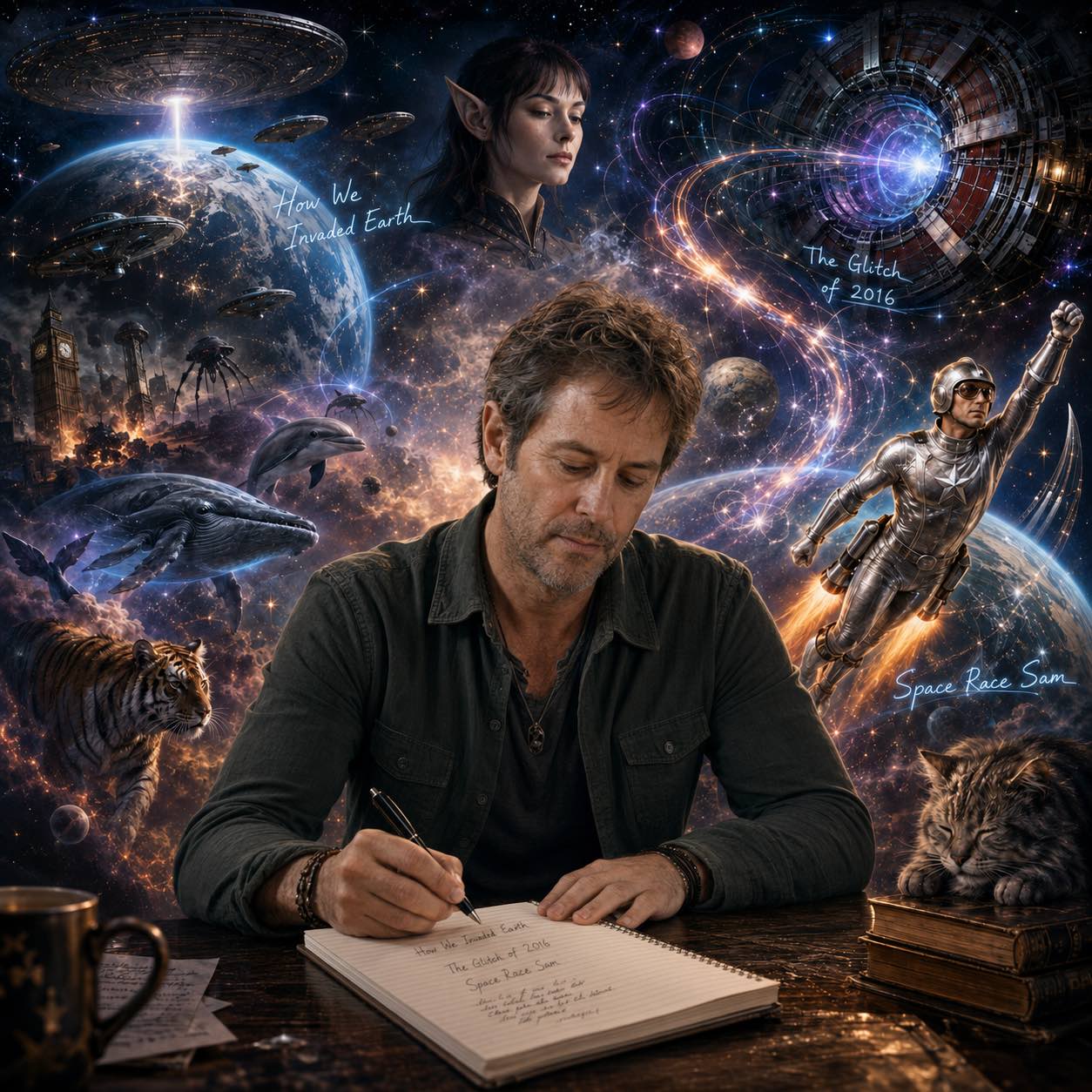
How we Invaded Earth
Space Race Sam
The Glitch of 2016
These are loosely science fiction story songs. They began as ‘concepts’, little story ideas and lyrical fragments. From there, I developed lyrics, hooks and sections that could guide the song. In some cases, I sang parts of the lyric, shaped a chorus or created a rough demo. Suno then helped build productions around those ideas.
What matters to me is that these are songs where the listener is meant to hear the words.
The lyrics are not simply texture. They are the point. They carry the story. They create the little world inside the song.
You can hear thse songs and more at The Radiation home page:
Why Suno can help lyrics find emotional depth
One thing I have found with Suno is that emotional prompting can matter as much as musical prompting.
You can describe a genre, of course. You can ask for rock, pop, folk, synthwave, cinematic music or any other style. But often the more useful instruction is emotional.
Melancholic but hopeful.
Darkly comic.
Grand and ridiculous.
Small and intimate.
Like a memory breaking apart.
Like a child’s dream turning into a warning.
Writers and lyricists are often good at this. They may not know the technical language of production. They may not know how to describe a drum sound, a compression setting or a chord extension. But they know what the piece should feel like.
That is powerful.
If you can describe the emotional world of a lyric, AI music tools can often help you explore musical versions of that world.
Why this matters for poets, lyricists and writers
There are many people who write words but have never been able to turn them into music.
They may write poems.
They may write stories.
They may write private lyrics.
They may scribble lines in notebooks.
They may have titles, choruses or strange ideas that never became songs.
In the past, those people needed a collaborator. That could be wonderful. Collaboration is one of the great joys of music. But it also means needing the right person, the right budget, the right time and the right studio process.
AI-assisted music gives those writers another option.
It lets them hear what their words might become.
That does not mean every poem should become a song. Some poems would quite rightly object and hide under the carpet. But for many writers, the chance to experiment with music can unlock something new.
It can make lyrics feel alive.
Why lyrics and poetry are not quite the same
There is an important point here.
Writing lyrics is not the same as writing poetry.
They overlap, but they are different crafts. A poem can sit on the page and ask the reader to meet it there. A lyric has to travel through a voice, a rhythm and a melody. It has to leave space for music.
My personal view is that many pop lyrics need a certain simplicity of thought and shape. That does not mean they should be stupid. Far from it. Simple is not the same as shallow.
A good lyric often says something clearly enough to be heard in real time.
The listener cannot go back and re-read the line unless they choose to. They hear it once, inside music, at speed. So the best lyric writing often uses direct emotional language, strong images, simple rhymes and memorable turns of phrase.
That is especially important with AI-assisted music.
If a lyric is too dense, the song may struggle to breathe. If every line is packed with cleverness, the melody has nowhere to sit. Sometimes one plain phrase can do more than eight dazzling ones standing on each other’s shoulders.
Why metre and rhyme still matter
AI music can do clever things with rhythm. Sometimes it will find a strange delivery that feels fresh and unexpected. Odd phrasing can create character. A line that should not quite work may suddenly work beautifully.
That is one of the pleasures of using it.
But AI can also force lyrics into a tune. When that happens, the result can sound awkward. A line may be stretched, rushed or squeezed into place.
This is why metre and rhyme still matter.
A strong lyric gives the AI useful information. It tells the system where the stresses are. It suggests where the chorus lifts. It gives the vocal something natural to sing.
In other words, old craft still helps new technology.
That is the part people sometimes miss.
Why AI music does not remove human taste
AI can generate a lot of music quickly. That does not mean all of it is good.
The human job is still to choose, reject, rewrite and refine. You have to listen hard. You have to know when a version has missed the point. You have to spot when the production sounds impressive but the song has no heart.
That is where experience helps.
I feel comfortable using AI music partly because I have spent decades writing songs, playing guitar, making demos and working with production. I know how songs behave. I know when a line is landing badly. I know when a chorus is nearly there but not quite.
AI can create options. It cannot care which one is right.
The writer has to do that.
Why the AI music debate still matters
Every article about AI music should acknowledge the wider concern.
There are strong feelings around AI music, and they are understandable. Many musicians, singers, producers and rights holders are worried about training data, consent, payment, imitation and the long-term effect on human musicianship.
Those concerns should not be brushed aside.
The future should not be one where people stop learning instruments, stop working with musicians or stop valuing the craft of recording. It should not be one where the people whose music helped shape AI systems are ignored.
AI music needs fairness. It needs transparency. It needs better answers around rights and reward.
But it also needs imagination.
There is a positive creative story here too. AI-assisted music can help some writers turn ideas into songs. It can help lyricists hear their words. It can help storytellers build musical worlds they could not otherwise afford to create.
Both things can be true.
Why The Radiation could not exist in this form without Suno
The Radiation is a good example of what AI-assisted music can make possible.
Songs such as Space Race and When We Invaded Earth have a scale and production ambition that would have been difficult to achieve on a small budget through traditional recording. They can sound grand, cinematic and fully realised because Suno helps build that world.
That does not make the human part disappear.
The concepts, lyrics, prompts, hooks, taste and decisions still matter. The song still needs to be shaped. It still needs a reason to exist. But Suno makes it possible to reach a production level that would once have required a much larger budget and team.
For a songwriter, that is not a small change.
It means ideas can move.
Why AI music may ignite more creativity
The best way to think about AI music is not only as a challenge. It is also a spark.
For some people, it may reignite old ideas.
For others, it may open a new form of writing.
For lyricists, it may turn private words into public songs.
For storytellers, it may create miniature musical worlds.
That does not mean everyone has to like it. Some people will reject AI music completely. That is their right.
But for those who are curious, I would suggest trying it. Write a lyric. Write a story. Write a chorus. Put emotion into the style description, not just genre. See what comes back. Then edit. Rewrite. Reject the weak versions. Keep your taste switched on.
Used well, AI does not have to flatten creativity.
It can supercharge it.
Listen to The Radiation and judge the songs
The best argument for AI-assisted music is not an argument at all.
It is listening.
The Radiation includes songs where the lyrics and stories are meant to be heard. How we Invaded Earth, Space Race and The Glitch of 2016 all began with human ideas and lyrics, then developed through AI-assisted production. They are not children’s songs, although they do share some DNA with the storytelling instincts behind Rockford’s Rock Opera.
They are little science fiction tales in song form.
Listen to them here:
Then decide what you think.
Not all AI music will be good. Not all human music is good either, as anyone who has survived a school recorder concert can confirm.
But when AI helps a writer bring lyrics, story and emotion into a finished song, something interesting is happening.
And that may be one reason why AI music could make lyrics important again.
FAQs about AI music, lyrics and songwriting
Can AI music make lyrics more important?
Yes, AI music can make lyrics more important because production is now easier to generate. When many people can create polished-sounding tracks, the words help decide whether a song has identity, meaning and emotional value. Strong lyrics give AI-assisted music a human centre. They can create story, character, humour, sadness and surprise. This makes lyric writing one of the most important parts of the process.
Is Suno useful for lyric writers?
Suno can be very useful for lyric writers because it allows them to hear their words as finished songs. A writer can begin with a lyric, story idea, title or emotional direction, then use the platform to explore musical treatments. The best results usually come when the lyric has clear rhythm, structure and feeling. Suno is most powerful when the human writer gives it something specific to develop.
Can poets use AI music tools?
Yes, poets can use AI music tools, although poetry and lyrics are not exactly the same. A poem may work beautifully on the page but need editing before it works as a song. Lyrics often need space, repetition, rhythm and clear emotional movement. AI music tools can help poets hear which lines sing naturally, which feel too dense and which ideas might become choruses or story songs.
What is the difference between lyrics and poetry?
Lyrics are written to be sung, while poetry is usually written to be read or spoken. Lyrics need to work with melody, rhythm, breath and repetition. They are heard in real time, so they often need clarity and shape. Poetry can be more complex on the page because the reader can pause and return to a line. Good lyrics can be poetic, but they also need musical function.
Why do story songs work well with AI-assisted music?
Story songs work well with AI-assisted music because the writer can begin with plot, character and emotional direction. The lyric can define what happens before the production is created. This gives the AI a stronger creative framework. A good story song needs human imagination, not just a style prompt. AI can help create the sound, but the story still needs a writer behind it.
Should AI-assisted songwriters still learn music?
Yes, learning music is still valuable. AI tools can create impressive productions, but musical knowledge helps a writer judge whether a song works. Understanding rhythm, melody, structure and phrasing can improve the lyric and guide better prompts. Playing an instrument is not essential for everyone, but musical craft still matters. AI can help generate options, but human judgement decides which options are worth keeping.
Can AI music replace human musicians?
AI music can replace some tasks in some situations, but it should not replace the value of human musicianship. Musicians bring personality, taste, performance, collaboration and lived experience. There are also serious questions around rights, training data and payment. The healthiest future for AI music is one where technology opens new creative routes while human musicians and rights holders are respected.
How can writers make better AI-assisted songs?
Writers can make better AI-assisted songs by starting with strong lyrics, clear emotion and a specific idea. Avoid vague lines and empty phrases. Think about who is speaking, what changes in the song and what the listener should remember. Use simple but memorable language. Then test versions, edit carefully and reject anything that sounds impressive but does not serve the lyric or story.
How does The Radiation use AI-assisted lyrics?
The Radiation uses AI-assisted music to develop Matthew Sweetapple’s original lyrics, ideas, hooks and demos into finished songs. Tracks such as Memories Unlimited, Space Race and The Glitch of 2016 began as concepts and lyrical story ideas before being shaped through music and Suno-assisted production. The aim is to put words, story and atmosphere at the heart of the finished track. Listen at https://theradiation.co.uk/
What is Sweetapple Music’s view on AI and lyrics?
Sweetapple Music sees AI-assisted music as one creative route, not a replacement for traditional songwriting or musicianship. Matthew Sweetapple continues to value non-AI projects such as Rockford’s Rock Opera while using The Radiation to explore what happens when human lyrics, story ideas and demos are developed through Suno-assisted production. The approach is open, experimental and centred on human-written songs.
About the author: Matthew Sweetapple
Matthew Sweetapple is an award-winning songwriter, composer, producer and creative agency founder. He has written music for television, advertising, and long-form musical storytelling projects over many years.
Matthew is one of the creators of the award-winning Rockford’s Rock Opera, a series of ecological musical stories created with Steve Punt and Elaine Sweetapple. The project combines songs, narration, characters, sound design and storytelling, and was created without AI.
He is also a founder of Sweetapple, where he has worked across music, sound, storytelling, advertising and creative strategy. His perspective on AI-assisted music is shaped by decades of practical songwriting experience, especially in the relationship between lyrics, melody, story and finished production.
Matthew’s current project, The Radiation, explores how human-written songs, lyrics and demos can be developed through AI-assisted music production.
The Radiation: https://theradiation.co.uk/
Sweetapple: https://www.sweetapple.co.uk/
Rockford’s Rock Opera: https://rockfordsrockopera.com/
Leave a Reply