Article summary
A story song is a song that does more than express a feeling. It tells us something happens. A character appears, a world opens, a problem begins and the listener is carried through a small musical narrative.
For Matthew Sweetapple, story songs have always mattered. From childhood favourites such as Peter and the Wolf, Sparky’s Magic Piano, Tubby the Tuba, Puff the Magic Dragon and The Ugly Duckling, through to his co-authorship of Rockford’s Rock Opera, storytelling and music have always belonged together.
Now, through AI-assisted music and The Radiation, story songs have become a new creative focus. Tools such as Suno make it possible to start with lyrics, characters and narrative ideas, then turn them into fully produced songs. This article explores why story songs are difficult, why they can appeal to listeners of all ages and why AI music may give them a new life.
What is a story song?
A story song is simply a song that contains a narrative.
It may tell a complete tale from beginning to end. It may sketch a character. It may describe a strange event. It may leave the listener with a twist, a warning or a small emotional wound that refuses to tidy itself away.
Not every song with lyrics is a story song.
Many songs capture a feeling. Love, anger, sadness, longing, regret, joy or confusion. That is perfectly valid. But a story song has an extra element. Something happens.
A story song asks the listener to follow.
Who is this about?
Where are we?
What changes?
What is at stake?
Why should I keep listening?
Those questions are close to the heart of songwriting. They are also close to the heart of storytelling.
Why I have always loved story songs
I have loved story songs for as long as I can remember.
As a child, I was drawn to records that created worlds. I liked songs and musical stories where characters appeared, instruments spoke, strange things happened and the music seemed to open a door into somewhere else.
That probably explains a lot about my later life.
I became a songwriter, composer and co-author of Rockford’s Rock Opera, a musical adventure story created without AI. Rockford’s Rock Opera is not simply a collection of songs. It is a story with songs at its centre. It uses music, characters, narration and sound to build a whole world.
That instinct has never left me.
With The Radiation, I have been exploring something slightly different. Not just stories with songs, but stories inside songs.
That is a small difference, but an important one.
Why story songs are difficult to write
Story songs are hard because songs are short.
A novel can take its time. A film can build a whole visual world. Even an audio drama can let scenes unfold. A song has only a few minutes to do everything.
That means a story song needs discipline.
You cannot explain too much.
You cannot overload the verse.
You cannot make every line carry plot.
You still need a chorus.
You still need rhythm.
You still need emotional shape.
If you put too much story into a song, it can start to sound like someone reading a plot summary over a backing track. If you put in too little story, the listener may not know what is happening.
The best story songs leave space for the listener’s imagination.
They suggest the world rather than explaining every brick in it.
How AI-assisted music helps story songs
AI-assisted music has changed how I approach this.
In the past, I often began a song with a guitar. I would find chords, hum a melody, let a few half-formed words appear, then gradually discover what the song was about.
That can still be a wonderful process.
But writing with AI, especially Suno, allows the lyric or story idea to come first.
I can begin with a character.
I can begin with a warning.
I can begin with a strange science fiction idea.
I can begin with a title.
I can begin with a whole little story.
Then I can shape the lyric before worrying too much about production.
That is empowering because it allows story ideas to survive the first stage of songwriting. They are not forced too early into the chord shapes my hands happen to know.
The lyric can lead.
The story can lead.
The song can grow from that.
Why lyrics matter in story songs
In a story song, the lyric is not decoration.
The lyric is the engine.
It has to create the scene, carry the voice, move the story and still be singable. It has to work as language and as music. That is not easy.
This is where AI-assisted music becomes interesting. If production tools can help create grand, strange, cinematic or emotionally rich sound worlds, the lyric has even more responsibility.
The words have to justify the production.
A huge sound around a vague lyric can feel empty. But a strong story lyric can make the production feel earned.
That is the opportunity. AI can build big worlds, but the writer still has to decide what happens inside them.
From Peter and the Wolf to The Radiation
One of the great musical storytelling works is Peter and the Wolf by Sergei Prokofiev.
Composed in 1936, it was written as a symphonic tale for children. Each character is represented by an instrument or group of instruments, helping young listeners hear how orchestral sound can carry personality, mood and action.
The bird is not just “the bird”. It has a musical identity. The wolf has a sound. Peter has a sound. The orchestra becomes a cast of characters.
That idea is still thrilling.
It shows children that music can tell stories without needing to explain everything in words. It also shows that instruments can act. They can creep, flutter, growl, swagger and worry.
That is a lesson every songwriter can use.
Sparky, Tubby and the musical stories of childhood
I also remember musical stories such as Sparky’s Magic Piano and Tubby the Tuba.
Sliding from the sublime to the ridiculous, perhaps, but I loved them.
Sparky’s Magic Piano now sounds very dated, but the idea is still charming. A little boy’s piano starts playing itself. Sparky becomes famous because of it, until the piano stops helping and he has to face the need to learn properly.
There is a moral there, gently wrapped in fantasy.
Tubby the Tuba is another lovely example. The tuba wants a melody of its own. That is such a simple and satisfying idea. It gives a large, often background instrument a voice, a character and a longing.
These are not story songs in the strictest sense. They are more like stories with music. But they show how powerful musical storytelling can be, especially for children.
They also show why music can make a story stay in the mind.
Puff the Magic Dragon and the ache of growing up
A true story song that has always stayed with me is Puff the Magic Dragon.
Whatever theories have surrounded it over the years, the song itself works beautifully as a simple, heartbreaking story about childhood, imagination and growing up.
Puff is loved by little Jackie Paper. They play together. They share a magical world. Then Jackie grows older and Puff is left behind.
That is a devastating idea, especially when you hear it as a child and only half understand why it hurts.
Good story songs often do that. They say something simple on the surface, but adults hear the deeper loss underneath.
That is why some so-called children’s songs are far better than the label suggests. They can speak to children and adults at the same time.
The Ugly Duckling and songs for every age
The Ugly Duckling, famously performed by Danny Kaye, is another story song that has stayed in the cultural memory.
It is a clear story. A rejected little bird turns out to be something beautiful. The structure is simple, but the emotional idea is strong.
That is one of the reasons story songs often work well for children. They give shape to feelings. Rejection, loneliness, hope, bravery and transformation can be made understandable through character and tune.
But I do not think story songs have to be only for children.
Adults need stories too. We may pretend to be very sophisticated, but we still want characters, twists, jokes, warnings, memories and strange little worlds. Sometimes we just want them with better coffee.
Why story songs can work for adults
There is no reason story songs cannot be written for adults.
In fact, many of the best songs are story songs in one form or another. They might tell a crime story, a love story, a memory, a confession, a journey or a warning.
What matters is not whether the subject is childish or adult. What matters is whether the song makes the listener care.
My own work has often aimed to reach across ages. Rockford’s Rock Opera was created for children and families, but it contains ideas about extinction, loss, friendship, memory and responsibility. Those are not small themes.
With The Radiation, the story songs are not children’s songs. Some lyrical content is not suitable for children. But they still share the same instinct: tell a story, make it sing and give the listener something to follow.
How The Radiation uses AI to create story songs
The Radiation has allowed me to take story songs further.
Using Suno, I can begin with a concept and lyric, then explore how that story might sound. I can use prompts to suggest emotion, scale, atmosphere and musical world. I can then listen, reject, rewrite, adapt and choose.
The AI does not know why the story matters.
That part is mine.
But it can help create a production world that would once have been difficult, slow or expensive to build. It can make a science fiction idea sound grand. It can make a memory song feel dreamy and unsettling. It can make an alien warning sound like something half comic and half alarming.
That is enormously useful for story songs.
Space Race Sam: a superhero story song
Space Race Sam is one example.
It tells the story of an unlikely 1960s-style superhero on rocket boots who has to save the Earth from a comet. It is ridiculous, grand and heroic in the best possible way.
A song like that needs scale. It needs fun. It needs a sense of danger without becoming grim. It needs to feel as if it belongs to a colourful world of comic-book bravery, space-age optimism and musical adventure.
AI-assisted production makes that possible.
I could begin with the story idea and lyric, then use Suno to help build the sound world around it. The finished song can become bigger than the demo. The scale can match the absurdity and drama of the idea.
That is exactly where AI can help a story song fly.
Rocket boots optional, but helpful.
Memories Unlimited: a story about the danger of living in the past
Memories Unlimited is another story song.
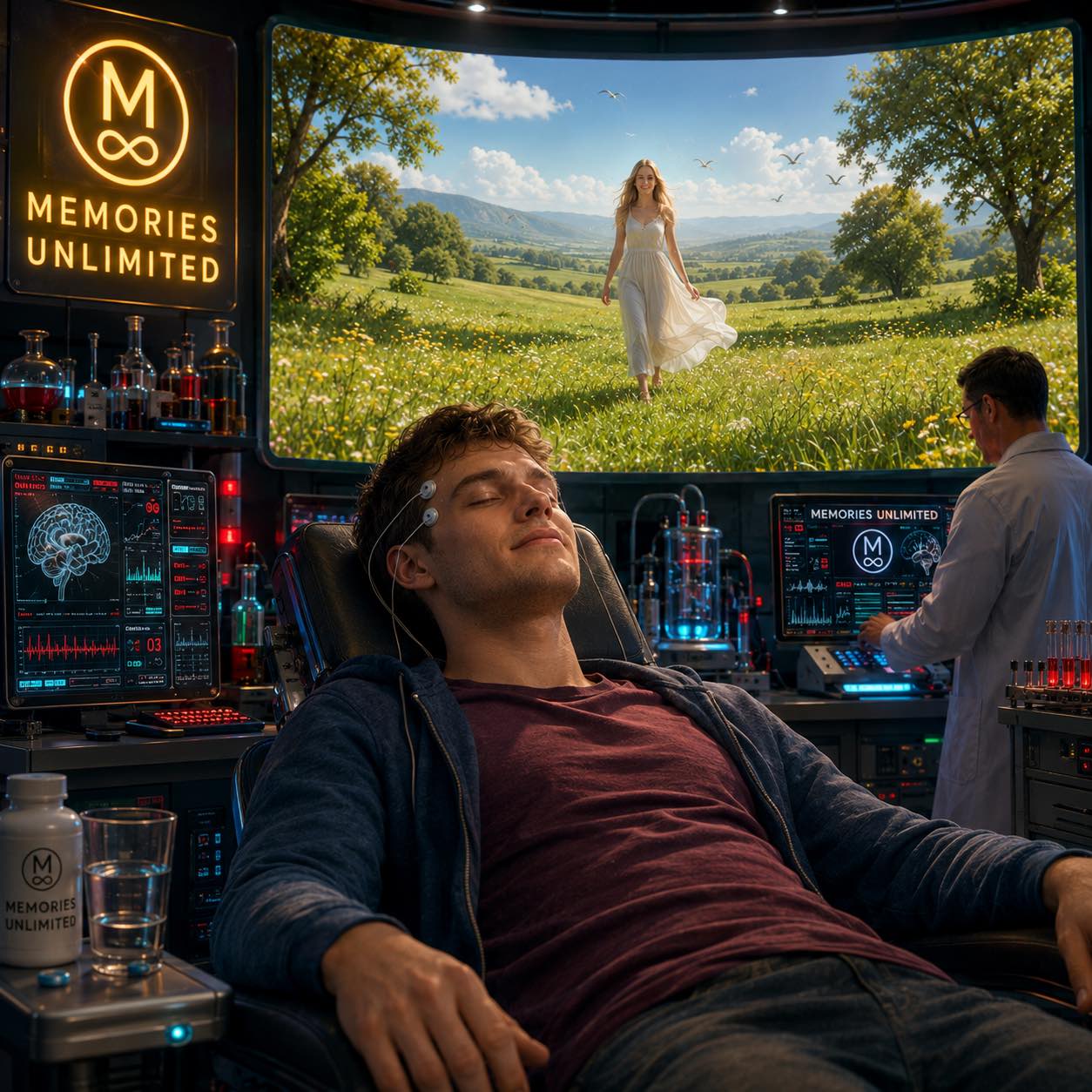
The idea is that we live with dreams of our past, often rose-tinted and edited by memory. What if, in the future, we could take a pill or use some technology to return to our happiest memories?
At first, that sounds wonderful.
But there is danger in it. If you can go back to the best moments of your life, why would you want to stay in the present? What happens when memory becomes an escape? What happens when nostalgia becomes a trap?
The song explores that idea through a science fiction lens.
It is not a lecture about mindfulness. It is a story. But underneath the story is a serious thought: perhaps we are better off living in the present than trying to rebuild the past.
That is the kind of idea AI-assisted music has helped me turn into a song.
When We Invaded Earth: a warning disguised as sci-fi
When We Invaded Earth is another Radiation track with a science fiction flavour.
It imagines an alien presence that arrived long ago and has been slowly, quietly working out how to take over. There is a faint echo of The War of the Worlds in that idea: intelligences observing, waiting and drawing their plans.
But the song is not only about aliens.
It is also a warning. If someone wanted to invade Earth now, how would they do it? Would they arrive in giant machines, or would they simply learn how our systems work, how our attention works, how our fears work and how easily we can be divided?
Science fiction is useful because it lets you talk about the present from an angle.
That is why story songs can be powerful. They can entertain first, then leave a question behind.
The War of the Worlds and musical storytelling
The War of the Worlds is another important reference point for me.
It is not a story song, strictly speaking. It is a larger musical and spoken-word work. But for anyone who grew up with it, the combination of narration, songs, orchestration and atmosphere was unforgettable.
It showed how music could help carry a large science fiction story. It could make machines feel huge, danger feel close and human panic feel strangely beautiful.
That kind of musical storytelling stays with you.
It certainly stayed with me. It also stayed with my son, which says something about how these works travel across generations when they are built on strong story, sound and atmosphere.
Why AI can help writers turn stories into songs
AI-assisted music is a powerful route for people who write stories, poems or lyrics but have not been able to turn them into songs before.
If your story rhymes, or even half-rhymes, you may already have the start of a lyric. If it has a strong character, a twist or a clear emotional shape, it may be closer to a song than you think.
Suno and other AI music tools can help you test that.
You can write the story.
You can shape the chorus.
You can describe the emotional world.
You can ask for mystery, comedy, sadness, grandeur or danger.
You can hear what comes back.
Then the real work begins.
You edit. You listen. You rewrite. You decide whether the song is worth keeping.
AI can open the door, but you still have to walk through it without falling over the furniture.
Are story songs only for children?
No. Story songs are not only for children.
Children often love them because they are clear, memorable and imaginative. But adults love stories too. We always have.
A good story song can be funny, dark, romantic, political, nostalgic or strange. It can be about a dragon, a spaceship, a lost love, a town, a crime, a family secret or the end of the world.
The important thing is that it should make the listener want to know what happens next.
That is a rare gift in songwriting.
It is also one of the reasons I think AI-assisted music may help story songs find a new audience. It gives writers the tools to build musical worlds around ideas that might otherwise never have become songs.
Listen to The Radiation story songs
If you are interested in story songs, I would suggest starting with these three Radiation tracks:
Space Race Sam
Memories Unlimited
When We Invaded Earth
They are all different, but each began with a story idea and lyric. Each uses AI-assisted production to build a world around the words. Each is meant to be listened to as a song, but also followed as a story.
You can hear them at:
If you write stories, poems or lyrics yourself, they may also give you a sense of what is now possible.
AI-assisted music will not make every idea work. It will not rescue a weak lyric, at least not for long. But it can give story-led writers a new way to hear their ideas.
That is exciting.
And for those of us who grew up loving dragons, talking pianos, singing tubas, orchestral wolves and alien invasions, it feels like a door has opened.
FAQs about story songs and AI-assisted music
What is a story song?
A story song is a song that tells a narrative rather than simply expressing a feeling. It usually includes a character, situation, event or emotional journey. Something happens during the song. The story may be simple, funny, sad, strange or dramatic. Good story songs still need melody, rhythm and structure, but the lyric carries more of the listener’s attention than in many other types of song.
Are story songs only for children?
No, story songs are not only for children. Many children enjoy them because they are clear and imaginative, but adults also respond strongly to songs with narrative. A story song can deal with memory, love, loss, comedy, science fiction, politics or personal experience. The important thing is not the listener’s age. The important thing is whether the song makes people care what happens next.
Why are story songs hard to write?
Story songs are hard because a song has limited space. The writer has to create character, setting, movement and emotion in only a few minutes. Too much plot can make the lyric feel clumsy. Too little story can make the song feel vague. The best story songs suggest a world quickly, then let the listener’s imagination help complete it. That takes skill and restraint.
Can AI music help write story songs?
AI music can help story songs by allowing writers to begin with a lyric, story idea or character before deciding the final sound. Tools such as Suno can then help explore production styles, moods and arrangements. The story still needs human imagination and editing. AI can create a musical world around the lyric, but it does not know why the story matters.
What makes a good story song lyric?
A good story song lyric needs clarity, rhythm and emotional movement. The listener should understand who or what the song is about, while still having space to imagine. Strong images help. So does a chorus that carries the central idea. The lyric should avoid explaining everything. A story song works best when it gives enough detail to follow, but not so much that it becomes a lecture.
What are some famous examples of musical storytelling?
Examples of musical storytelling include Peter and the Wolf, Tubby the Tuba, Sparky’s Magic Piano, Puff the Magic Dragon, The Ugly Duckling and The War of the Worlds. Some are story songs, while others are stories with music or larger musical works. What they share is the use of music to create character, atmosphere and narrative movement that listeners remember.
Why do story songs work well with science fiction?
Story songs work well with science fiction because the lyric can quickly introduce a strange idea, then let the music build the world around it. Science fiction also allows writers to talk about real life indirectly. Aliens, memory machines, comets and future worlds can all become ways of exploring fear, nostalgia, hope or human behaviour. A strong concept can give the song instant momentum.
Can writers turn poems or stories into songs with AI?
Yes, writers can use AI music tools to explore whether poems or stories might work as songs. A poem may need simplifying, reshaping or adding repetition before it becomes singable. A story may need a chorus or clearer emotional centre. AI can help test musical direction, but the writer still needs to edit carefully. The best results come from strong words and clear intention.
How does The Radiation use story songs?
The Radiation uses AI-assisted music to turn Matthew Sweetapple’s story ideas, lyrics, hooks and demos into finished songs. Tracks such as Space Race Sam, Memories Unlimited and When We Invaded Earth began with concepts and lyrical storytelling before being developed through Suno-assisted production. The aim is to create songs that listeners can follow as miniature stories, not just hear as tracks.
What is Matthew Sweetapple’s background in musical storytelling?
Matthew Sweetapple is co-author of Rockford’s Rock Opera, a non-AI musical adventure story that combines songs, narration, characters and ecological themes. That storytelling background feeds into The Radiation, where he explores AI-assisted story songs for a wider audience. His work often begins with lyrics, characters and ideas, then uses music to make those stories more vivid and memorable.
About the author: Matthew Sweetapple
Matthew Sweetapple is an award-winning songwriter, composer, producer and creative agency founder. He has written music for television, advertising, singles and long-form musical storytelling projects over many years.
Matthew is one of the creators of the award-winning Rockford’s Rock Opera, a series of ecological musical stories created with Steve Punt and Elaine Sweetapple. The project combines songs, narration, characters, sound design and storytelling, and was created without AI.
He is also a founder of Sweetapple, where he has worked across music, sound, storytelling, advertising and creative strategy. His perspective on AI-assisted music is shaped by decades of practical songwriting experience, especially in the relationship between lyrics, melody, story and finished production.
Matthew’s current project, The Radiation, explores how human-written songs, lyrics and demos can be developed through AI-assisted music production.
The Radiation: https://theradiation.co.uk/
Sweetapple: https://www.sweetapple.co.uk/
Rockford’s Rock Opera: https://rockfordsrockopera.com/
Leave a Reply