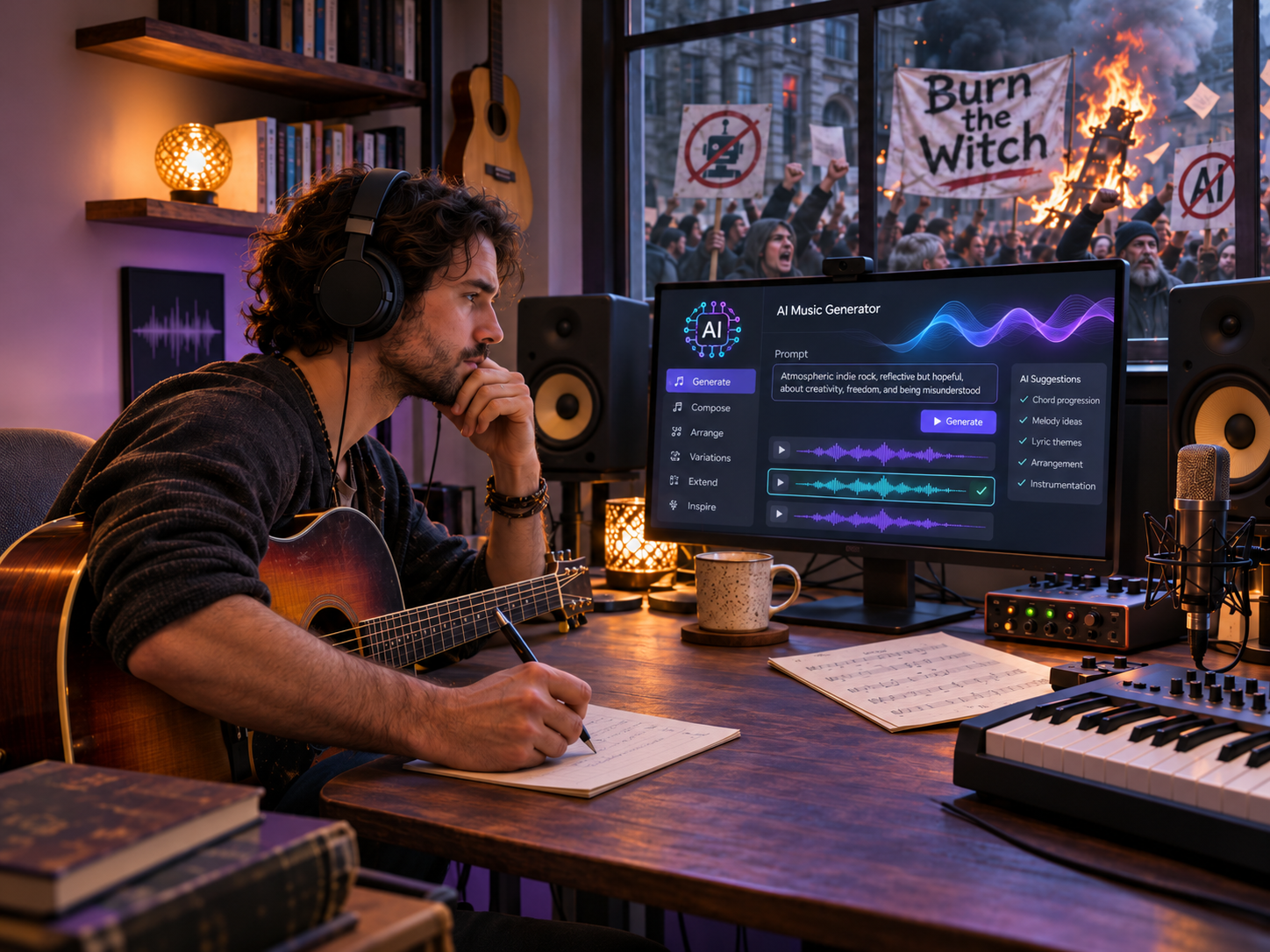
There seems to be an increasingly vicious reaction to the use of AI in creative work. And it’s not just happening in music.
I’ve seen it in publishing, illustration and pretty much every creative field. An author admits to using AI to help edit a manuscript, an artist uses it to develop an idea or a musician incorporates it into a recording, and suddenly the accusations begin.
AI slop! Not real art! You’re not a proper creator! I’m going to get you…
Sometimes, it seems, even using AI to check your spelling is enough to provoke outrage.
Now, I’m not naive. I know that some of the people making these comments are simply trying to provoke a reaction. That’s how social media works. It’s even possible that some creators rather welcome the controversy because, as we all know, arguments are wonderful things for algorithms.
But take those people out of the equation and there’s still a substantial amount of real and rapid hostility towards AI.
A willingness to dismiss something simply because AI has been involved, without considering how it was used, why it was used or how much actual human creativity went into the finished work.
And I think that’s a shame.
Not all AI creativity is the same
I’ve written before about the different levels of AI involvement in music, and I don’t particularly want to go over all that ground again.
But there is clearly an enormous difference between someone typing a random prompt into an AI music generator and accepting whatever comes back, and someone spending days or weeks developing a song, writing lyrics, experimenting with arrangements, adjusting performances and making hundreds of creative decisions along the way.
There are all sorts of variations between those two extremes. You might use AI to produce an entire track, to create a backing for your own lyrics, to add instruments to an existing recording or simply to help with mastering.
And the same is true of writing and illustration.
To dismiss all these different approaches as the same thing seems to me rather silly.
But that’s not really what I want to talk about here.
What interests me most is something that seems to get rather lost in all the arguments.
AI enables amazing human creativity.
The person who comes up with the idea
I’ve spent a great many years writing songs, composing music, producing recordings and generally coming up with creative ideas.
I won’t say precisely how many years. Let’s just say it’s quite a lot.
And I’ve always thought of myself as someone who sits, in a sense, at the top of the creative tree.
Now, before that sounds horribly arrogant, I absolutely don’t mean that in terms of talent, status or importance. There are countless musicians, singers, producers and writers who are considerably more talented than I am.
I’m certainly not the world’s greatest guitarist. And I make absolutely no claim to being the world’s greatest singer.
But I do enjoy writing lyrics. I can occasionally come up with a good tune. And I have ideas.
Lots of them.
What I mean by being at the top of the creative tree is simply being the person who comes up with the original idea… the concept. The person who imagines something and then wants to see, hear or read the finished result.
Traditionally, that person has needed a whole range of other people to make the idea a reality.
If you’re writing a book, you might need editors, designers and illustrators. If you’re creating a record, you might need musicians, singers, arrangers, producers and engineers.
And if you can’t do all those things yourself, you either need a great deal of time, a considerable amount of money or some very generous and talented friends.
Ideally, all three.
For someone like me, AI has changed that equation rather dramatically.
Making music I could never have afforded to make
The Radiation currently contains around fifty songs, created with varying degrees of AI involvement.
And I can say with absolute certainty that the vast majority of those finished recordings simply wouldn’t exist without AI.
It’s not that I would otherwise have hired a string orchestra, a brass section, several session singers and a producer for every track. How could I possibly have recorded the orchestra needed on tracks like ‘When we invaded Earth’ or ‘Here’s to Nothing’?
I wouldn’t.
I couldn’t afford to.
The songs would have remained as demos, half-finished recordings or ideas sitting in a folder on my computer. Some might eventually have seen the light of day. Most probably wouldn’t.
With AI, I can take those ideas considerably further.
I can try arrangements that would previously have been impossible for me. I can experiment with different musical styles. I can hear a song performed in ways that I might have imagined but could never realistically have achieved.
And I can keep experimenting.
That’s something I find utterly brilliant and inspiring.
The interesting thing is that, despite the enormous variety of musical styles on The Radiation, I still think the songs sound very much ‘like me’. It’s still MY music!
The arrangements might be radically different from anything I could have produced myself, but the ideas, the lyrics, the musical tastes and the decisions behind them are recognisably mine.
At least, I hope they are.
I’ve probably created fifty finished pieces in the time it might previously have taken me to produce ten. And those ten would almost certainly have been much more limited in their musical scope.
That’s an extraordinary creative opportunity.
And I’m sure I’m not alone.
What about all the people who might lose work?
Now, I can already hear the objections.
And some of them are entirely justified.
Because, of course, there is another massive side to this.
The musicians, producers, arrangers, engineers and countless other extraordinarily talented people who have traditionally helped turn creative ideas into finished works may find that some of that work disappears.
That’s a genuine concern.
I know how much skill goes into music production. I’ve spent a considerable part of my life doing it, often with other musicians and producers whose abilities far exceed my own.
And I certainly wouldn’t want to live in a world where those skills were no longer valued.
There is also a serious question about what happens to the next generation.
If AI can produce a convincing guitar performance in seconds, will fewer young people bother spending years learning to play the guitar?
If it can arrange, mix and master a song, will fewer people develop the skills needed to become excellent music producers?
And if it can write a perfectly serviceable piece of prose, will some people never discover the satisfaction of learning to write well themselves?
We should all genuinely worry about that. But the solution can’t be just to ban all AI… it’s too late, and the opportunity is too compelling.
There is a difference between using AI to extend your abilities and using it instead of developing any abilities in the first place.
And I don’t pretend to know where all this will lead.
There are also perfectly reasonable questions about copyright, the material used to train AI systems and whether creators have been fairly treated or compensated.
These aren’t imaginary problems. They deserve proper discussion and, where necessary, proper solutions.
But I don’t think any of that means we should automatically condemn/threaten to behead every creator who chooses to use AI.
My very talented, slightly scatty assistant
Perhaps the best way I can describe my own relationship with AI is that it’s rather like having an incredibly talented but occasionally rather scatty assistant.
An assistant who knows an astonishing amount about music, who can apparently play almost anything, who never seems to get particularly tired and who is always happy to have another go.
Of course, like any enthusiastic young assistant, it sometimes has ideas of its own.
Some are very good.
Others are completely wrong or boring.
Sometimes it seems to have misunderstood the brief entirely. Sometimes it insists on doing something I specifically asked it not to do (especially when it comes to OTT vocals!). And sometimes it produces something so unexpectedly good that I end up changing my original plans.
But the great pleasure is that I can work with it.
I can experiment, reject things, change direction, develop ideas and keep trying until I get something I’m happy with.
And, rather wonderfully, it doesn’t get offended when I tell it that its last attempt was rubbish.
I suspect some of the musicians I’ve worked with over the years might have appreciated that particular quality.
But seriously, it has become a fascinating creative companion.
And I still spend an enormous amount of time working on the music.
AI may make certain processes faster, but it doesn’t automatically make the creative decisions for me. At least, not the ones I choose to accept.
There is still a human being behind these recordings, making choices, changing things, listening, rewriting and occasionally wondering why on earth something that sounded brilliant yesterday sounds quite dreadful this morning.
Some things never change.
What about people who couldn’t create before?
There’s another aspect of this that I find particularly interesting.
I’ve been fortunate enough to spend much of my working life doing creative things. I have some musical knowledge, some production experience and a reasonable understanding of how songs are put together.
But what about someone who doesn’t have those skills?
Someone who has a wonderful idea for a story but struggles to write it.
Someone who hears music in their head but has never learnt to play an instrument.
Someone with an extraordinary imagination who, for whatever reason, has never had the opportunity, money or confidence to turn that imagination into something tangible.
Should those people be excluded from creating finished work?
I don’t think so.
Of course, learning the traditional skills is a wonderful thing. I would encourage anybody who wants to make music to learn an instrument, write songs and understand how recordings are made.
But I also love the idea that someone who might otherwise never have created anything can now produce something that gives them, and perhaps other people, real pleasure.
Will everything they create be wonderful?
Of course not. (Taste and talent will always prevail.)
But then, an awful lot of music produced by human beings isn’t wonderful either. In fact, a lot of it is total Human Slop…
I’m sure we’ve all heard some of it.
The ability to create something doesn’t guarantee that it will be good. That has always been true.
But surely giving more people the opportunity to express their ideas is, in itself, something worth celebrating.
Can we please stop attacking each other?
What I find most depressing about the whole AI argument is the sheer hostility.
I understand why some creative people are frightened. I understand why others are angry. I understand why someone who has spent thirty years perfecting a skill might feel rather dismayed when a computer appears to replicate aspects of it in a few seconds.
Those feelings deserve respect.
Equally, I think creators who are using AI thoughtfully, imaginatively and openly deserve some respect too.
There is room for disagreement. There is certainly room for criticism.
If a piece of music is dreadful, say it’s dreadful. If a book is badly written, criticise the writing. If a picture is unimaginative, explain why.
But dismissing something purely because AI was involved, without knowing anything about the process or the person behind it, is unfair.
And attacking people for being open about their use of AI seems particularly counterproductive.
Surely honesty is something we should be encouraging?
We already live in a world with more than enough division, anger and people shouting at each other.
Do we really need another reason to fall out?
I’d much rather have a sensible conversation about how AI can be used responsibly, what protections creators need and how we can preserve the skills and traditions we value while still enjoying the possibilities these new tools offer.
We might even discover that we agree on rather more than we think.
A final word about The Radiation
Which brings me back to my own musical experiment.
The Radiation is a collection of songs I’ve created using AI to varying degrees.
Some have involved a great deal of AI assistance. Others considerably less.
But every track has involved me, my ideas, my musical tastes and a great deal of time spent trying to make something I actually want to listen to.
I don’t claim they’re all masterpieces. I’m rather fond of some of them, and others I actually love.
And I certainly couldn’t have created this range of finished recordings, in anything like the same time, without AI.
For me, it has opened up a wonderful creative outlet.
If you object to AI being used in music in any form, I completely respect that. There are plenty of other things to listen to, and I would never suggest that anyone should abandon their principles to hear my songs.
But if you’re happy to give AI-assisted music a chance, I hope you’ll spend a little time listening to The Radiation.
You may like some of it. You may dislike some of it. You may even find something that surprises you.
And if you do listen, I’d simply ask you to remember that there’s a real person behind the music.
Someone who has spent an awful lot of years writing songs, coming up with ideas and trying to turn the music in his head into something other people can hear.
These days, I’m fortunate enough to have a remarkably talented, endlessly enthusiastic and occasionally completely infuriating little friend to help me do it.
And I’m having fun.
Matthew Sweetapple
The Radiation
Leave a Reply