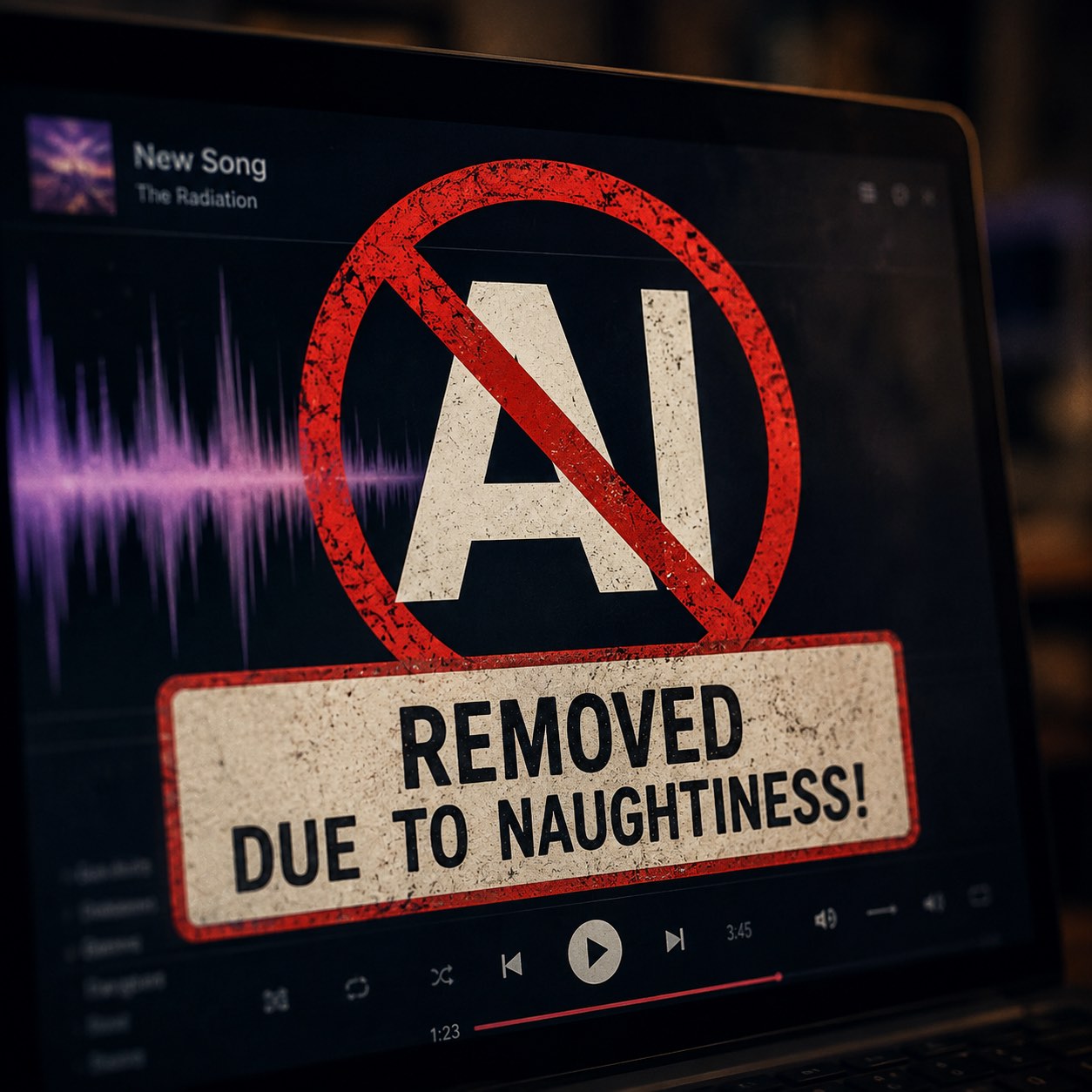
I received an email today from one of the music distributors I have used to get my some of my music onto Spotify, Apple Music and the other streaming platforms.
Some of my recent releases use AI so they need to come DOWN NOW!
Am I surprised?
Not really.
Do I understand why the music industry is struggling with AI?
Absolutely.
Do I think simply banning music because AI was involved in making it is a sensible solution?
No. I think it is becoming ridiculous.
And, more importantly, I don’t think it is going to achieve what the music industry presumably wants it to achieve. It’s simply putting more power into the hands of people (including musicians and producers) who are already successful.
First, let me make something very clear
I have said this before and I’ll keep saying it.
Companies such as Suno need to find a proper commercial relationship with the musicians, songwriters and rights holders whose work has been used to train their systems.
If copyrighted music has been used without permission to build commercial AI products, that problem needs resolving. Creators need to be properly recognised and, where appropriate, paid.
I have no argument with that whatsoever.
In fact, as a songwriter myself whose work has been used, I have a fairly obvious interest in it.
But that is a problem concerning the relationship between AI companies and the music industry.
It is not solved by pretending that every piece of music involving AI is somehow the same thing.
Because it isn’t.
I wrote these songs
The Radiation is my AI-assisted music project.
In the vast majority of cases, the process starts with me.
I write the lyrics.
I write the melody.
I write the chords.
I record a demo.
I then put that work into Suno and use AI to develop it into a finished production.
Yes, AI is involved. Quite substantially. And, in some cases, yes, I do also use Suno to generate tunes from my lyrics too.
I’m not trying to hide that. The whole point of The Radiation is partly to explore what this extraordinary new technology allows a songwriter and writer to do.
There are also songs where I have written the lyrics and used Suno to help generate or develop the music itself. I am perfectly happy to describe those differently.
But putting all of this into one enormous bucket marked evil, bad AI MUSIC is absurd.
There is a world of difference between a songwriter spending hours or days writing a song, recording it and using AI as a production tool, and somebody typing:
“Write me a kpop song about a dolphin that falls in love with a clam.”
Press button.
Song appears.
Upload.
Whatever you think of either approach, they are plainly not the same creative process.
Yet increasingly we seem to be developing rules that treat them as though they are.
And here is where it gets really stupid
Pretty much every songwriter, musician and producer I know is now experimenting with AI in some form.
Some use it for ideas.
Some use it for arrangements.
Some use it for demos.
Some use it for voices.
Some use it for production.
Some use it much more extensively.
The genie is not going back into the bottle. It has already booked the studio.
But there is a crucial difference between musicians using these tools.
!MONEY!
Imagine two songwriters.
Both write their own song.
Both use AI to help develop it.
Both end up with an AI-assisted recording they love.
Songwriter A has money, contacts and access to studios.
So they take that AI production into a studio. They employ musicians. They hire a singer. They recreate the arrangement using conventional recording techniques.
They now have a recording made by human musicians (great if you can afford it).
Songwriter B doesn’t have £500, £5,000 or £20,000 to do that.
So they release the AI-assisted version.
Same songwriter.
Same creative idea.
Same technology involved in developing the work.
But one can potentially get through the gate and the other can’t.
Does that really protect emerging, struggling songwriters?
It’s a complex situation that can’t be solved with sledghammer approach.
It may actually do the opposite
This is the bit that really bothers me.
AI has given independent songwriters access to capabilities that previously required serious money.
I can write a song and hear it performed and produced in ways that would once have required musicians, singers, engineers, producers and studio time.
That raises legitimate questions about the livelihoods of all those people.
Of course it does.
We cannot simply shrug and say technology changes things. There needs to be a serious conversation about licensing, consent and remuneration.
But there is another side to this.
For the first time, somebody sitting at home with a guitar, a piano or a battered old keyboard can experiment with production on a scale previously available mainly to people with money or industry connections.
And what are we now proposing?
You can use this extraordinary new creative tool.
You just can’t release the result.
Unless, of course, you’ve got enough time and money to get people into a studio and recreate it afterwards.
That’s progress?
Label it. Fine.
One of the other distribution services I use asks whether AI has been involved in creating the recording.
I say yes.
Fine.
I have absolutely no objection to that.
If streaming services want recordings labelled as AI-assisted, AI-generated or entirely AI-generated, I actually think that could be useful.
It would certainly be more intelligent than pretending these things are all identical.
We could have meaningful distinctions.
Human-written, AI-assisted production.
Human lyrics, AI-generated music.
AI-assisted composition.
Fully AI-generated.
Those descriptions tell us something.
“AI: prohibited” tells us almost nothing.
We’ve been here before, although this time is bigger
I appreciate that comparing generative AI with synthesisers, drum machines, sampling, Auto-Tune or computer-based recording only gets you so far.
AI is different.
The questions around training data and the ability to imitate human creativity are much bigger.
But there is one similarity.
Every major technological change in music alters what an individual creator can do.
A songwriter once needed a band.
Then you could sequence instruments.
Then you could record an album on a laptop.
Then you could correct vocals, manipulate performances and create sounds that never physically existed.
Now AI has taken another enormous step.
The answer cannot simply be to draw a line around the latest technology and say music made using this tool isn’t allowed.
Especially when the people with enough money can simply recreate the exact same thing conventionally and walk straight through the door.
The real problem isn’t the song
For me, this is where the debate needs to go.
We need to sort out the commercial relationship between AI companies and the creative industries.
Who gave permission for training?
Who gets paid?
How should licences work?
How do we protect artists from deliberate imitation?
How do we distinguish genuine human authorship from industrial-scale automated content?
Those are difficult questions.
Banning anything with an AI fingerprint is easy.
But easy isn’t necessarily useful.
And it certainly isn’t a long-term solution.
I’m not angry with the distributor
Well, perhaps I’m a little irritated.
But I understand the position these companies are in.
They are caught between streaming platforms, record companies, musicians, copyright holders, regulators and a technology that is developing at an extraordinary speed.
Nobody has the perfect answer yet.
I certainly don’t.
But that’s precisely why we shouldn’t pretend that a blanket ban is an answer.
It isn’t.
The Radiation isn’t pretending not to be AI
That’s important to me.
The whole project is openly AI-assisted.
I’m fascinated by the technology.
I’m also uncomfortable with parts of the way the technology has been created.
Those two thoughts can coexist.
I want AI companies to reach proper licensing arrangements with the music industry.
I want musicians and songwriters to be paid fairly.
I want artists to retain control over their work.
And I also want a teenager sitting in their bedroom who has written a brilliant song to be able to use new technology to realise that song without needing £10,000 and a telephone full of industry contacts.
Those aren’t contradictory positions.
In fact, I think they’re part of the same argument.
Because if we’re serious about protecting creativity, we should probably start by asking where the creativity came from.
Not simply what technology touched it on the way to becoming a record.
Rant over.
For now.
FAQs
Is The Radiation AI-generated music?
The Radiation is an AI-assisted music project. The creative process varies between songs. In most cases I write the lyrics, melody and chords myself, record a demo and use AI tools such as Suno to develop that material into a finished production. In some cases AI has played a larger role in generating the music.
Do you think AI-generated music should automatically be accepted by streaming platforms?
No. Streaming platforms and distributors have every right to establish rules about what they distribute. My argument is that simply dividing music into “AI” and “not AI” fails to recognise enormous differences in how that music was created.
Should AI music be labelled?
I have no problem with clear labelling. In fact, I think categories explaining the degree of AI involvement could be far more useful than a simple yes/no distinction.
What about musicians whose work was used to train AI systems?
This needs to be addressed. AI music companies need sustainable licensing arrangements with musicians, songwriters, publishers and other rights holders. Creators should have appropriate control over and remuneration for commercial uses of their work.
Isn’t AI taking work away from real musicians?
Potentially, yes. That is one of the difficult consequences the music industry needs to confront. But preventing independent musicians from releasing AI-assisted recordings does not necessarily solve it, particularly when wealthier artists can use the same technology during development and then pay to recreate the resulting production conventionally.
Is using AI really comparable with using a synthesiser or Auto-Tune?
Not completely. Generative AI raises much bigger questions around training data, copyright, imitation and authorship. The comparison is useful in one respect, though. Music has repeatedly been transformed by technologies that allow individuals to do things that previously required more people, equipment and money.
What would be a better approach?
A more useful system would distinguish between different levels of AI involvement, require transparency where appropriate and develop proper licensing arrangements between AI companies and rights holders. Human-written, AI-assisted music should not automatically be treated as identical to music generated almost entirely from a prompt.
So are you anti-AI or pro-AI?
Neither label is particularly useful. I’m a songwriter using a new creative tool. I want that tool to exist within a system that respects and pays the people whose work helped make it possible. I don’t think protecting musicians and embracing new creative technology have to be opposing positions.
Leave a Reply