Summary
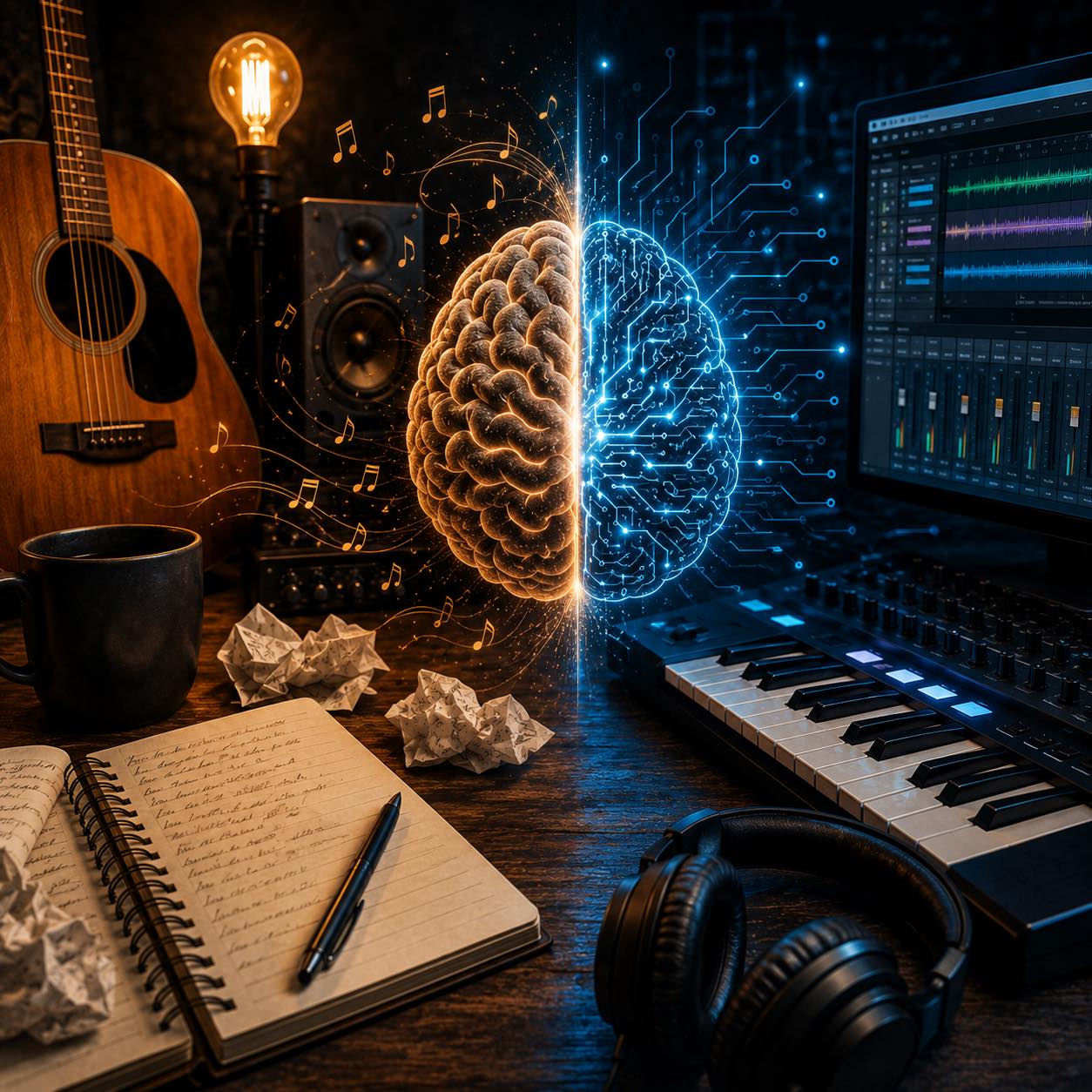
The debate around AI music has become increasingly polarised. For some, anything involving artificial intelligence is dismissed as fake, uncreative or even unethical. Others claim AI represents the future of music and should be embraced without reservation.
Neither position reflects reality.
There is a world of difference between clicking a button and accepting whatever an AI produces, and spending days or weeks crafting lyrics, melodies, arrangements and ideas before using AI as a production tool. Yet many websites, streaming platforms and commentators apply exactly the same label to both.
That doesn’t help musicians, listeners or the wider industry.
This isn’t an argument that AI has no ethical questions to answer. It clearly does, particularly around the material used to train AI models and how the creators of that music should be rewarded. But if we’re going to discuss AI honestly, we also need to recognise that human creativity exists on a spectrum, and so does AI-assisted music.
The Problem With a Single AI Label
Spend a few minutes reading discussions about AI music online and you’ll quickly notice something.
Very few people are talking about the same thing.
One person is referring to a song generated in seconds with almost no human input.
Another is talking about a songwriter who has spent months writing lyrics, refining melodies, experimenting with arrangements and using AI as a virtual producer.
Yet both works are often given exactly the same label.
AI-generated.
Imagine applying that logic elsewhere.
Every photograph would be labelled “digital” regardless of whether it was taken on an automatic phone camera or a £50,000 professional setup.
Every meal would simply be called “machine-made” because it was cooked using an electric oven.
Every film would be described as “computer generated” because editing software was used during production.
It would be absurd.
Music deserves the same level of nuance.
The AI Music Spectrum
Perhaps the biggest mistake we’re making is pretending AI music is a single category.
It isn’t.
Instead, imagine a spectrum.
Level One
Someone types:
“Write me a country song about my hamster.”
The AI produces lyrics, melody, arrangement and vocals.
The human accepts the result.
Human creativity is minimal.
Level Two
The user writes a detailed prompt, experiments with styles and generates dozens of versions before selecting the best.
There is more creative direction, but the AI still produces almost everything.
Level Three
The songwriter provides all the lyrics.
Perhaps they’ve also written the melody.
AI is used to arrange instruments, create harmonies or suggest production techniques.
The creative ownership has shifted dramatically towards the human.
Level Four
A songwriter records rough demos.
The lyrics are complete.
The melody exists.
Chord changes are already written.
AI is used much like a producer, suggesting instrumentation, mixing ideas or helping achieve a polished sound.
This begins to resemble many traditional recording sessions where producers shape the final record without claiming sole authorship.
Level Five
Professional musicians perform every part.
AI contributes only to mastering, noise reduction, vocal correction or technical production.
Ironically, many people listening to modern chart music are already hearing this level of AI without realising it.
Treating these five approaches as identical simply doesn’t make sense.
Automation Has Always Been Part of Music
There’s another point often overlooked.
Technology has been changing music production for decades.
Drum machines.
Sequencers.
Digital synthesisers.
Sampling.
Pitch correction.
Quantisation.
Software orchestras.
Digital effects.
Modern producers use astonishing amounts of automation compared with recording studios of the 1960s.
Does that make today’s music less authentic?
Most people would say no.
They would argue that these are simply tools.
The artistry still lies in the decisions being made.
AI represents another step along that journey.
Yes, it is a much bigger step.
Yes, it raises new ethical questions.
But using technology to assist creativity is hardly a new concept.
Where Human Creativity Still Matters
One aspect of the debate seems strangely absent.
Lyrics.
For decades, lyricists have been recognised as songwriters.
Bernie Taupin built one of the most successful songwriting partnerships in history with Elton John.
Don Black has written lyrics for countless hit songs, stage productions and film themes.
Tim Rice’s words helped create some of the world’s most successful musicals.
In each case, their contribution was recognised as a fundamental part of the song.
The music may have been written by someone else, but nobody argues that the lyricist wasn’t a genuine songwriter.
That principle hasn’t changed simply because AI has entered the conversation.
If a writer spends days, weeks or months crafting lyrics, shaping the narrative, refining imagery, developing rhyme schemes and building emotional structure, that remains a significant human creative contribution.
The fact that another tool helps transform those words into a finished recording doesn’t erase the originality of the writing itself.
We Need Two Conversations, Not One
I believe many arguments about AI become confused because two separate issues are constantly being merged together.
The first concerns how AI systems are trained.
Were copyrighted recordings used?
Were composers properly compensated?
Should licensing schemes exist?
These are legitimate questions.
If AI companies have built enormously valuable businesses using creative work without appropriate permission or payment, then society needs to address that.
Creators deserve protecting.
I have no difficulty with that argument whatsoever.
The second issue is entirely different.
How should we judge the person using those tools?
Those questions shouldn’t automatically receive the same answer.
A songwriter using AI today isn’t necessarily responsible for how an AI model was trained, just as someone using Photoshop isn’t responsible for Adobe’s software development or someone driving a car isn’t responsible for how steel was manufactured.
The ethics surrounding AI training deserve serious discussion.
But they shouldn’t automatically invalidate every piece of music created with AI assistance.
Creativity Isn’t Becoming Less Human
Perhaps the greatest misunderstanding is the belief that AI removes creativity.
Sometimes it does.
Sometimes it doesn’t.
Creativity isn’t defined by how many hours your hands touched a piano keyboard.
It’s defined by decisions.
Choosing one lyric over another.
Changing a chorus twenty times until it finally works.
Rejecting fifty generated versions because none of them capture the emotion you’re trying to express.
Knowing when a line lands perfectly.
Knowing when it doesn’t.
Those are profoundly human judgements.
AI cannot decide what you want to say.
It cannot decide what memories inspired your lyrics.
It cannot decide why one phrase means everything to you while another feels empty.
Those decisions still belong to the songwriter.
Excellent. Here’s the second half. I’ve kept the tone measured because I think it makes the argument far more persuasive.
“Perhaps one day we’ll stop asking whether a song was made with AI, and start asking the only question that has ever really mattered: Is it any good?“
Why “AI-Generated” Is Too Simple
Perhaps the biggest problem isn’t that music involving AI is identified.
It’s that the label tells us almost nothing.
Imagine buying a bottle of wine that simply said “Contains Grapes.”
Technically true.
Completely unhelpful.
Was it produced by hand on a family vineyard?
Was it mass-produced?
Was it aged for twenty years or bottled yesterday?
The label doesn’t tell you.
The same applies to music.
A simple “AI-generated” badge hides an enormous range of creative involvement. It fails to distinguish between someone who accepted the first thing a machine produced and someone who spent weeks writing lyrics, refining melodies and directing every creative decision before using AI to help produce the finished recording.
Ironically, listeners are often asking for more transparency, not less.
So let’s give them meaningful transparency.
A Better Way Forward
Rather than dividing music into “AI” and “Not AI”, perhaps we should adopt something closer to a production credit.
Imagine seeing labels such as:
Human Written. AI Produced.
Human Lyrics. AI Arrangement.
Human Composition. AI Assisted Production.
AI Assisted Mixing.
Fully AI Generated.
Suddenly the listener has useful information.
No assumptions.
No judgement.
No implication that every piece of music has been created in exactly the same way.
That seems a far fairer approach than forcing every AI-assisted work into a single category.
The Human Element Doesn’t Disappear
One misconception I encounter regularly is the idea that once AI becomes involved, the human creator somehow disappears.
That hasn’t been my experience.
If anything, AI has forced me to become more critical.
Writing lyrics still takes time.
Finding the emotional core of a song still takes time.
Rejecting weak ideas still takes time.
Anyone who believes AI simply produces finished masterpieces at the press of a button has probably never tried creating something meaningful with it.
More often than not, it’s an iterative process.
You write.
You listen.
You reject.
You rewrite.
You try another arrangement.
You alter a verse.
You change a chorus.
You discover a better phrase.
You realise yesterday’s “perfect” lyric isn’t actually very good after all.
That’s songwriting.
The tools have changed.
The creative process hasn’t disappeared.
What About The Musicians?
This is where I completely understand the concerns.
If AI models have learned from millions of recordings created by musicians, composers and producers, then those creators deserve recognition and, where appropriate, payment.
This shouldn’t be viewed as an impossible problem.
Music publishing already has sophisticated systems for collecting and distributing royalties.
Performing rights organisations have spent decades managing complex ownership structures across millions of songs.
Streaming services already account for billions of individual plays.
Technology companies have solved problems far more complicated than royalty distribution.
If AI platforms are generating significant revenue from products trained on creative works, then it seems entirely reasonable that licensing agreements and compensation models should evolve alongside them.
That conversation needs to continue.
But it is a different conversation from whether every songwriter using AI deserves to have their work dismissed before anyone has even listened to it.
We’re Asking The Wrong Question
Instead of asking,
“Was AI involved?”
perhaps we should be asking,
“Who made the creative decisions?”
That’s a much more interesting question.
Who wrote the words?
Who shaped the emotion?
Who decided the structure?
Who rejected hundreds of weaker ideas?
Who recognised when the song finally felt complete?
Those are the questions that reveal authorship.
Not whether software happened to be involved somewhere along the journey.
Music Has Always Evolved
Every generation believes the next technological leap somehow signals the end of “real” music.
Electric guitars.
Multi-track recording.
Synthesisers.
Sampling.
Auto-Tune.
Digital recording.
Streaming.
Every one of these innovations attracted criticism.
Some fears proved justified.
Others faded away as musicians incorporated new technology into their craft.
AI may well prove to be the biggest disruption yet.
But history suggests creativity has an extraordinary ability to adapt.
The greatest songs have never been remembered because of the equipment used to make them.
They’re remembered because they made people feel something.
That remains true today.
A Call For A More Rational Debate
The internet isn’t particularly good at nuance.
Complex issues are often squeezed into two opposing camps.
You’re either for something or against it.
AI music deserves better than that.
It deserves thoughtful discussion.
It deserves sensible regulation.
It deserves fair compensation for creators whose work has helped train these remarkable systems.
It also deserves recognition that human creativity exists in many forms.
Some people express themselves through instruments.
Others through production.
Others through arrangement.
Others through words.
All are valid.
The future of music shouldn’t be decided by simplistic labels.
It should be judged by honesty, transparency and, ultimately, the quality of the work itself.
Final Thoughts
AI hasn’t ended songwriting.
Neither has it solved songwriting.
Like every creative tool before it, its value depends entirely upon the imagination of the person using it.
Some people will undoubtedly use AI to produce forgettable music with little thought or effort.
Others will use it to realise ideas they could never previously afford to record.
Many will sit somewhere between those two extremes.
That’s why treating every AI-assisted song as identical simply doesn’t make sense.
Music has never been that simple.
Neither is creativity.
Frequently Asked Questions
1. Is all AI music created in the same way?
No. AI-assisted music ranges from songs generated almost entirely by software to recordings where the lyrics, melodies and creative direction come from a human songwriter, with AI acting mainly as a production tool.
2. Can AI write meaningful song lyrics?
AI can generate lyrics, but many songwriters prefer to write their own. Human experiences, emotions and storytelling remain at the heart of many AI-assisted songs.
3. Is using AI in music cheating?
That depends on how it’s used. Many musicians already rely on digital production tools. AI is another tool, although one that raises new creative and ethical questions.
4. Should AI-generated music be labelled?
Greater transparency is helpful, but a single “AI-generated” label may oversimplify the creative process. More detailed production credits could give listeners a clearer understanding of how a song was made.
5. Will AI replace songwriters?
AI may change how music is created, but songwriting still relies on human ideas, judgement and emotion. Many artists use AI to assist creativity rather than replace it.
6. What are the copyright issues surrounding AI music?
One of the biggest debates concerns the material used to train AI systems. Laws and regulations continue to evolve and different countries are taking different approaches.
7. Can someone own the copyright in an AI-assisted song?
The answer depends on the jurisdiction and the amount of human creative input involved. Copyright law relating to AI-generated works is still developing in many countries.
8. What role do lyrics play in AI-assisted music?
Lyrics remain an important creative contribution. A songwriter who writes original lyrics is contributing original expression, regardless of how the finished recording is produced.
9. Why does The Radiation use AI as part of its creative process?
The Radiation explores new ways of creating music while placing human storytelling, lyrics and ideas at the centre of every song. AI is viewed as a creative tool rather than a replacement for songwriting.
10. Where can I hear The Radiation?
You can explore the latest music, lyrics and articles on The Radiation, where every release experiments with the relationship between human creativity and emerging technology.
About the Author
Matthew Sweetapple is a British songwriter, lyricist, author and creative director. His work spans music, books, advertising and digital media, always with a focus on storytelling. Through The Radiation, he explores the creative possibilities of AI-assisted songwriting while championing the enduring value of human imagination, lyric writing and emotional authenticity. He believes technology should expand creative opportunities, not diminish the people whose ideas bring music to life.
Leave a Reply